
The Bookkeeping Owner's Reality Check: 10 Signs You're Running a Job, Not a Business

You can have clients, employees, steady revenue, and a full calendar and still have built yourself a job instead of a business.
I think this gets harder to see in bookkeeping because being needed can look a lot like being successful. Clients ask for you by name. Your staff brings the odd questions to you. You know which client always sends something late, which one needs an extra reminder, and which account needs a second look before the financials go out. Being the person who knows all of that feels useful. It is useful. But it can also hide how much of the business still depends on you personally.
For me, the better question isn't whether you call yourself a business owner. It's what would still be there if you stopped working for a while. Would the work keep moving? Would clients still get answers? Would someone else know what needs reviewed before a set of financials goes out? Would revenue continue without you quietly checking email from wherever you were supposed to be taking time off?
That's where the difference between owning a business and owning a job starts to become a lot easier to see.
Table of Contents
The Test That Reveals It
10 Honest Signs You're Running a Job, Not a Business
Why This List Feels Uncomfortable
What Changes It
What to Do With This
Frequently Asked Questions
The Test That Reveals It
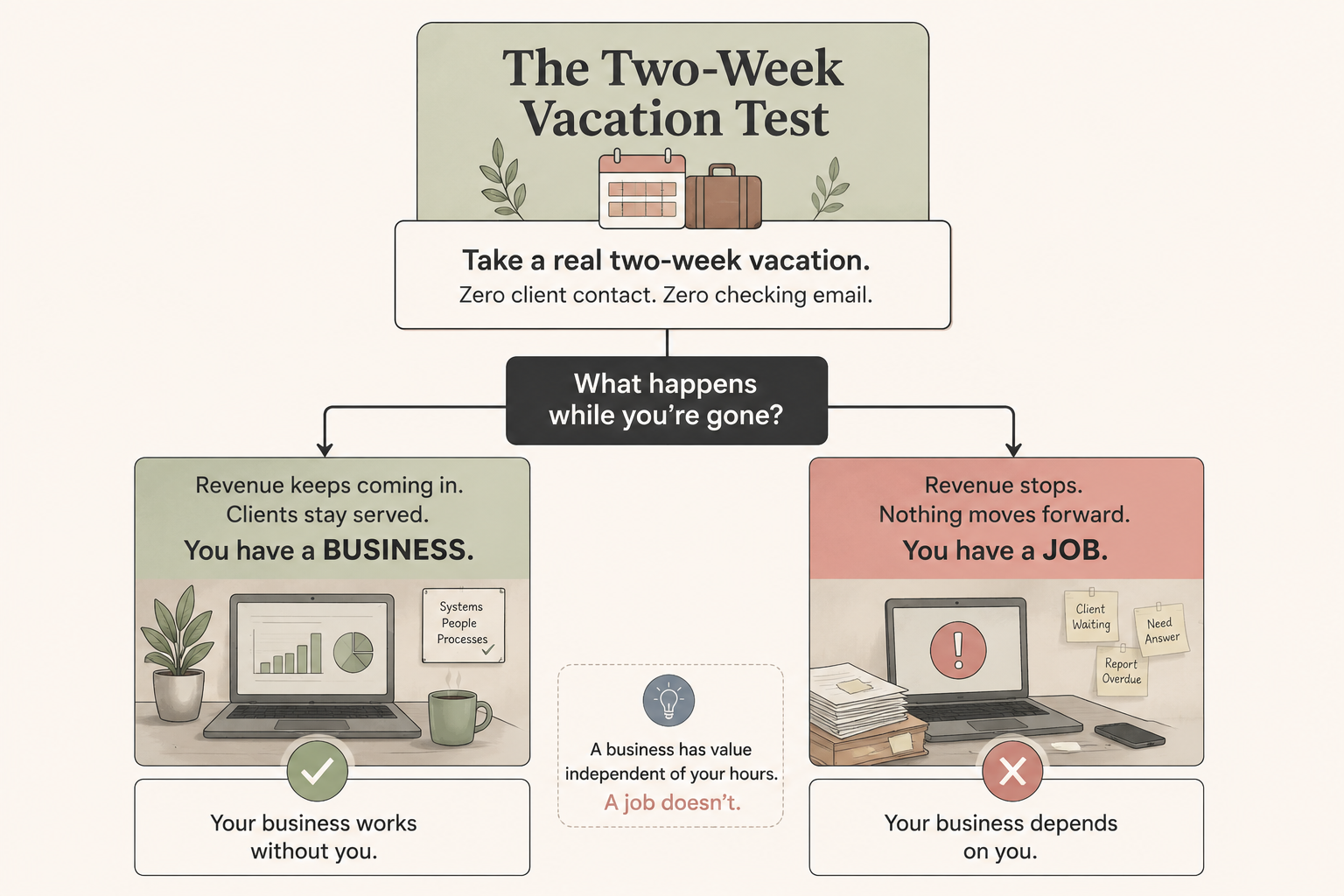
The easiest test I know is a real two-week vacation. Not a week where you take the laptop and work for an hour before everyone else wakes up. Not checking email at night because you only need to make sure nothing is on fire. Two weeks where the firm has to operate without you.
Think about what would actually happen during those two weeks. A client sends a question that isn't covered by the normal monthly workflow. A bank feed breaks. Something unusual shows up during review. A staff member needs to know whether a transaction should be handled the same way you handled it last month. Payroll has a problem five minutes before it needs submitted.
Who knows what to do?
That answer tells you more about the business than the number of clients you have or how full your calendar is. If the team can work through normal issues, clients continue to be served, and revenue keeps coming in without you directing traffic, you've built something that can function apart from your own hours. If everything starts stacking up waiting for you, you know exactly where the business is still dependent on you.
Most owners don't need to literally leave for two weeks to see the weak spots. You can usually name them as soon as you picture being unavailable.
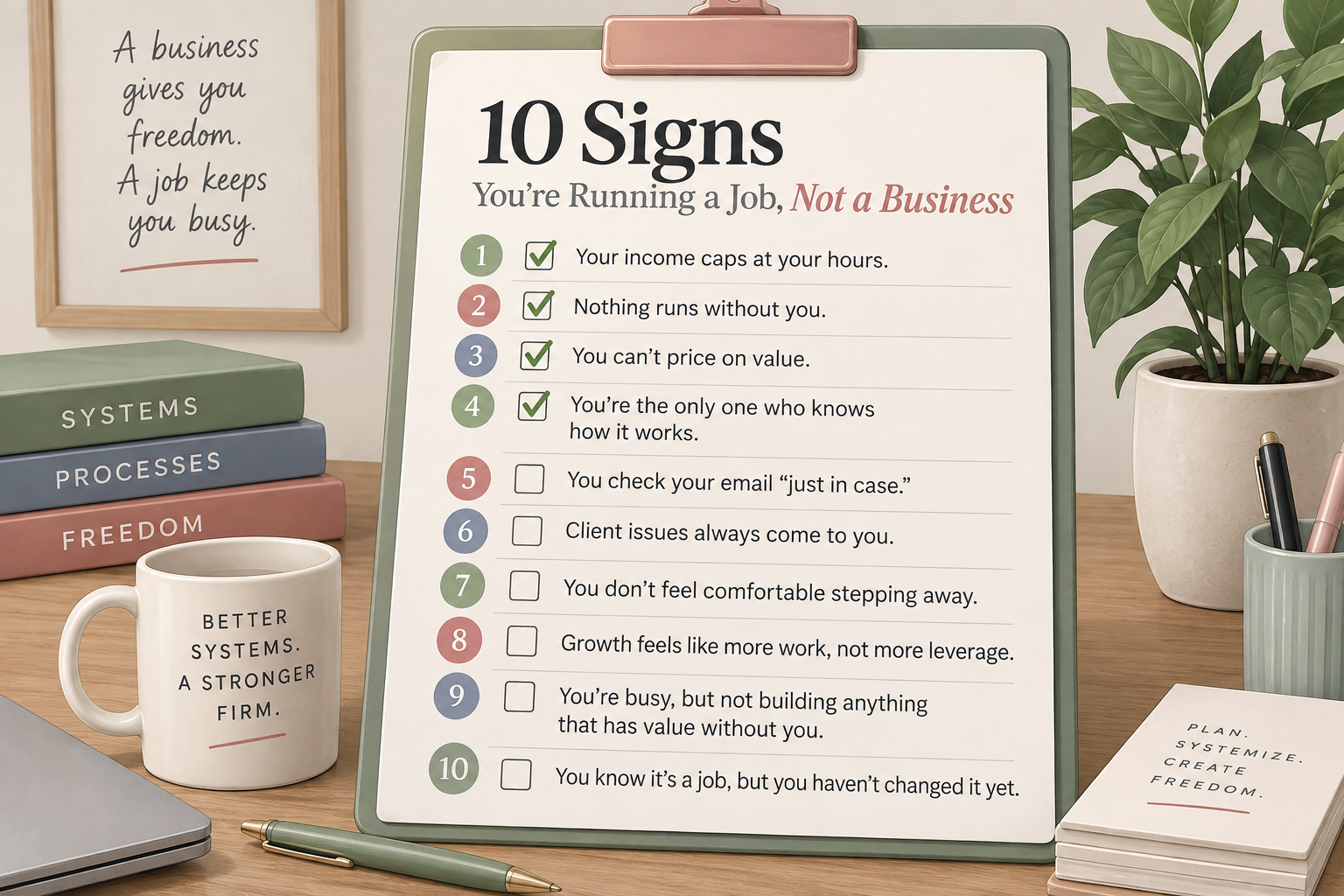
10 Honest Signs You're Running a Job, Not a Business
1. Your income caps at your hours.
This one can hide for a long time because the business may be making perfectly good money. The problem shows up when every increase in revenue requires you to absorb more work. Another client means another close you review, another inbox you watch, another set of questions that eventually finds its way to you.
There will always be owner work in a firm. But if the only way to increase revenue is to increase your own workload, you haven't created much leverage yet.
2. Work waits for you instead of moving without you.
Look at what happens when you're out of the office for a day. Does normal work continue, or do people make a mental pile of things to ask you when you get back?
The pile is the clue. It might be client questions, review items, an unusual transaction, a scope question, or something as small as nobody being sure whether a particular client prefers email or a portal message. One or two owner decisions are normal. A business full of work that routinely pauses for the owner is different.
3. You still price by calculating how much of your time a client will consume.
Even firms that charge fixed monthly fees can still be thinking hourly underneath the price. If every proposal starts with estimating how many hours you will spend doing the work, your own capacity is still setting the ceiling.
As a firm gets more systemized, pricing can account for complexity, responsibility, scope, risk, team capacity, and the value of the service instead of being a disguised calculation of the owner's available hours.
4. Important client knowledge lives in your head.
This is bigger than having a checklist for monthly close. Bookkeeping firms accumulate hundreds of tiny pieces of client knowledge: who wants reports by a certain date, which loan gets booked a particular way, who always needs a payroll reminder, what the CPA asks for at year-end, which client gets confused by the same report every month.
If those details disappear when you're unavailable, the firm hasn't actually retained the knowledge. You have. The Bookkeeping Firm Systems Audit can help you spot where that is happening.
5. Taking time off creates more work than staying.
A vacation shouldn't require you to spend the week before trying to get three weeks of work done. If you have to clear every review, answer every possible client question in advance, leave a page of special instructions, and still take the laptop because something will probably come up, that's useful information about the business.
Time off will always require some planning. It shouldn't require temporarily rebuilding the firm around your absence.
6. You have routines, but nobody else could reproduce them.
Bookkeepers are very good at building personal routines. We know the order we like to work in. We know what we check without thinking about it. We notice when an account looks wrong because we've looked at that account every month for years.
The problem comes when we call that a system. A routine becomes useful to the business when the important parts are documented well enough that another capable person can follow the process and understand what good work looks like.
7. Clients have a relationship with you, but not necessarily with the firm.
Strong client relationships are one of the best parts of this business. I wouldn't want to remove the owner from them completely. But there's a difference between clients knowing the owner and clients believing the owner is the only person who can help them.
If every question is addressed to you, every decision requires you, and a client becomes uncomfortable when someone else responds, the relationship hasn't expanded beyond you yet. That makes delegation harder and eventually makes your own availability part of the service you're selling.
8. There isn't much to transfer if you wanted to sell the business.
Imagine handing the firm to another experienced bookkeeper tomorrow. What are they actually receiving besides a client list and recurring revenue?
Are they getting documented workflows, client history, pricing and scope information, communication standards, staff who know their roles, a repeatable monthly close process, and records that explain how the firm operates? Those things are part of what makes a firm transferable. Without them, a buyer has to recreate too much of the business after you leave.
9. Growth keeps creating owner work.
This is the one I would watch closely in a growing firm. You hire someone, but now you're answering all of her questions. You add clients, but you're still reviewing every detail. You improve marketing, bring in more leads, and discover that every sales conversation still has to fit on your calendar.
Growth isn't helping much if every solution creates another job for the owner. At some point the question has to change from “How do I get more done?” to “Why does this still have to come through me?”
10. You've never deliberately tested the firm without you.
You don't have to disappear for two weeks tomorrow. Start smaller. Take a day off and pay attention to what waits. Stop answering a category of internal questions that someone else should be able to resolve. Let another team member own a client communication from beginning to end.
The goal isn't to prove that nobody needs you. The goal is to find the places where they need you only because the business never gave them another way to get the answer.
Why This List Feels Uncomfortable
Most bookkeeping businesses start with the owner doing nearly everything. Mine did too. When there aren't enough clients to support employees, sophisticated systems would be overkill. You learn the clients, do the work, answer the emails, send the invoices, fix the problems, and gradually figure out how you want the business to operate.
The trouble is that some of those early-stage habits keep working long after the business has outgrown them. The owner still answers because it's faster. She still reviews something because she always has. Client details stay in her head because she remembers them. Staff asks her because asking takes thirty seconds and documenting the answer takes longer today.
None of those decisions looks particularly dangerous by itself. Put enough of them together and you've built a firm where the owner is the shortcut for everything.
That's why I wouldn't look at this list as a score. I'd look for patterns. If you recognized yourself in #2, #4, #6, and #7, for example, you probably don't have four unrelated problems. You have a knowledge and documentation problem. If #1, #3, and #9 sounded familiar, capacity and pricing may be more important.
Systems Over Hustle gets into the same issue from the systems side: eventually adding more of your own effort stops being a workable growth strategy.
What Changes It
The answer isn't to remove yourself from the business. I still expect an owner to make owner-level decisions. Some client situations need experience. Some review issues deserve a second set of eyes. Pricing, hiring, capacity, service changes, and difficult client decisions aren't things I would automate away just to prove the firm can run without me.
What changes is the amount of routine work that reaches the owner simply because nobody has decided where else it should go.
That usually means documenting more than a checklist. A useful system answers questions such as: Who owns this? When does it happen? What does complete look like? What happens when something is unusual? Where is the client-specific information stored? When should the team escalate something instead of making the decision themselves?
Once those answers exist outside your head, you can train around them, improve them, and eventually stop being the default answer to every question.
What to Do With This
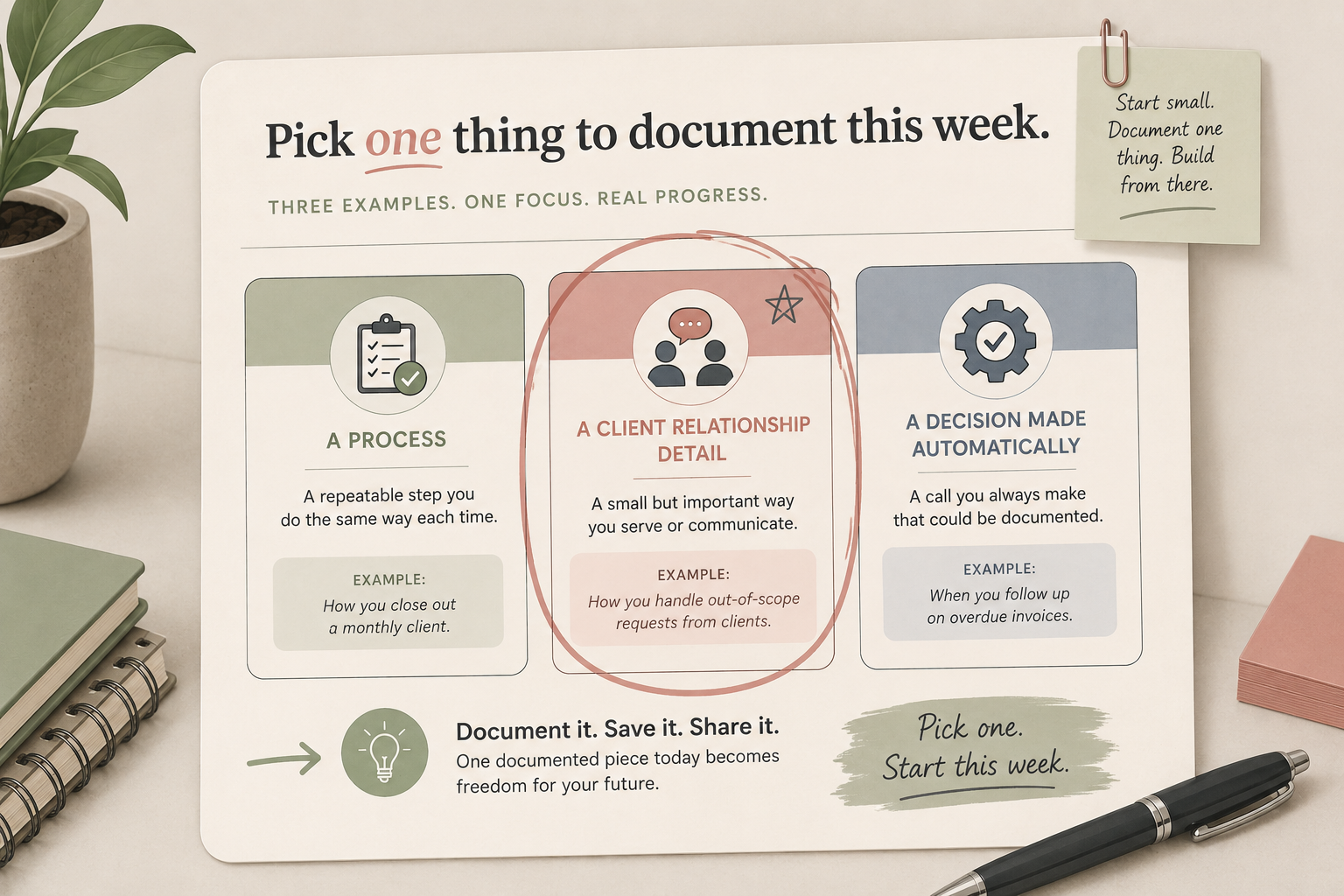
Don't try to fix all ten signs at once. Pick one place where work regularly comes back to you and figure out why.
Maybe it's a process nobody else can complete without asking questions. Document the missing steps and the exceptions you normally handle from memory.
Maybe it's client knowledge. Write down the details that would let another team member communicate with that client without sounding like a stranger.
Or maybe it's a decision you make automatically during review. The next time you make it, stop and write down what you noticed and why you chose the answer you did. That kind of judgment is often teachable once you slow down enough to explain it.
Then see whether the same question comes back to you next month. That's a much more useful test of whether the documentation worked.
Not sure where to start? The free Inspired Firm Dashboard is built to help you see the whole picture of your business at once, instead of guessing at which piece to tackle first.
Frequently Asked Questions
-
A bookkeeping business should have its core client, workflow, communication, review, and documentation systems in place before relying heavily on employees. The goal is not to document every possible situation first, but to make sure recurring work does not depend on the owner remembering how each client is handled.
-
Start by identifying the work, decisions, and client knowledge that routinely stop when you are unavailable. Document the repeatable parts, assign clear ownership, and build a consistent place for the team to find client details, procedures, deadlines, and review expectations.
-
The best work to delegate first is usually recurring, teachable work that does not require the owner's judgment every time. Look for tasks that happen frequently, follow a predictable process, and take meaningful time away from pricing, capacity planning, client strategy, hiring, and other owner responsibilities.
-
A bookkeeping business does not need to operate indefinitely without its owner to be a real business, but routine work should be able to continue during normal owner absences. Clients should still be served, staff should know where to find information, and most recurring decisions should not have to wait for the owner to return.
-
A bookkeeping business is more ready to scale when adding clients does not automatically require adding the same amount of owner time. Consistent workflows, documented client information, clear team responsibilities, reliable review standards, and visibility into capacity are stronger signs of scalability than revenue growth alone.
Related Resources
Why Posting More Doesn't Get Bookkeepers More Clients The same effort-versus-structure gap, applied to marketing instead of operations.
Stay Connected
The Inspired Bookkeeper on Substack
Deeper, more personal writing on running a bookkeeping business. Two posts a week.
Read on Substack →Inspired Modern Bookkeepers
The conversation doesn't have to end here. Bring it to the group.
Join the Group →Get Articles by Email
Weekly insights for bookkeeping business owners, straight to your inbox.
No spam. Check your inbox to confirm.