
Systems Over Hustle: Why Your Bookkeeping Business Needs Structure, Not More Hours

Most bookkeepers were taught how to do bookkeeping.
We learned how to reconcile accounts, clean up transactions, prepare financial reports, communicate with clients, and keep work moving through monthly deadlines.
What many of us were not taught was how to build the business around that work.
There is a difference between being a skilled bookkeeper and running a bookkeeping firm that is organized, consistent, and able to grow without everything depending on the owner.
That gap is one of the main reasons Bookkeeping Inspired exists.
Table of Contents
Why a Well-Run Firm Needs More Than Bookkeeping Skills
What Happens When Everything Lives in Your Head
Why Working Harder Is Not the Long-Term Fix
What a Firm System Looks Like
Five Signs Your Firm Needs More Structure
What Changes When the Business Stops Depending on You
One Process You Can Document This Week
Why I Built Bookkeeping Inspired
What You Will Find Here
Frequently Asked Questions
Why a Well-Run Firm Needs More Than Bookkeeping Skills
A bookkeeping firm can deliver accurate work and still feel difficult to run.
Client information may be spread across notebooks, spreadsheets, emails, task lists, and whatever the owner can remember from the last conversation.
Onboarding may look slightly different for every client.
The monthly close may depend on one person knowing which reports to review, which questions to ask, and which unusual items need attention.
Client follow-up may happen only when someone remembers to send it.
None of this reflects on the owner's care or ability. It's usually a sign the business grew faster than the operating structure behind it, which happens to almost any firm that takes on more than a handful of clients.
A process that works perfectly well with three clients may start to strain at fifteen. Add employees, more services, tighter deadlines, or a larger client base, and the gaps become harder to manage.
At that point, the problem sits in how work moves through the firm, not in the bookkeeping itself.

A process that works perfectly well with three clients may start to strain at fifteen. Add employees, more services, tighter deadlines, or a larger client base, and the gaps become harder to manage.
At that point, the problem sits in how work moves through the firm, not in the bookkeeping itself.
What Happens When Everything Lives in Your Head
Many firms rely heavily on the owner's experience and memory.
That can work for a long time because the owner knows the clients, understands the history, recognizes unusual activity, and remembers what needs to happen next.
The problem is that knowledge is difficult to share when it has never been documented.
Ask yourself this:
If you had to step away from the firm unexpectedly for two weeks, could someone else determine what needed to be done from the information already written down?
Could they see:
What work is due
Where client documents are stored
Which steps belong in the monthly close
What is still waiting on the client
How completed work is reviewed
What communication needs to be sent
If the answer is no, that's not about your bookkeeping skill. It means too much of the firm still depends on information only you know, and that's something you can fix starting with one process.
Why Working Harder Is Not the Long-Term Fix
When work starts slipping or deadlines feel harder to manage, the natural response is to put in more hours.
You answer messages sooner, stay at your desk later, check work again after dinner, and try to hold more details in your head.
That gets you through this week. It doesn't fix why this week felt hard in the first place, and next week will ask for the same hours again.
The goal isn't to remove judgment from the work; bookkeeping will always require it. It's to stop using judgment and memory for things that could already be decided, documented, and repeated once.
You shouldn't have to rethink onboarding with each new client, rebuild the monthly close from memory every month, or explain the same internal process a different way each time someone on your team asks about it.
The process should be documented once and improved as the firm learns what works.
What a Firm System Looks Like
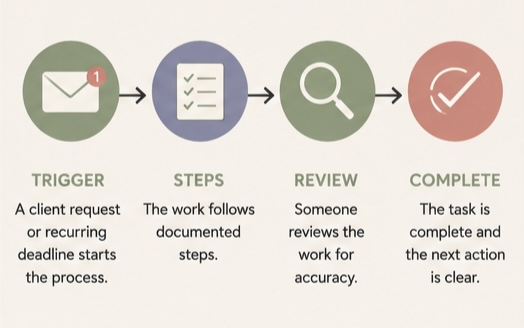
A system does not have to be complicated.
It is simply a defined way of completing a recurring part of the business.
A useful system answers questions such as:
What starts the process?
Who is responsible for each step?
What information or documents are needed?
What order should the work follow?
What needs to be reviewed?
How do we know the process is complete?
What happens next?
For example, a client onboarding system might include:
A signed agreement and completed payment setup
A standard welcome message
A list of required documents and access
Internal client setup
An assigned onboarding checklist
A defined handoff into recurring service
A monthly close system might include:
Confirming that documents and statements are available
Completing transaction review and reconciliations
Reviewing balance sheet accounts
Identifying open questions
Completing reviewer approval
Preparing and delivering reports
Documenting follow-up items for the next month
The exact steps will look different from firm to firm.
What matters is that the process is visible, repeatable, and not dependent on someone remembering every detail at the right moment.
Five Signs Your Firm Needs More Structure
Your firm may need a stronger system when:
You have explained the same process more than once, but it is still not written down.
Clients receive different experiences depending on how busy the firm was when they started.
Tasks occasionally slip through the cracks even though everyone is working hard.
You cannot take a full day away without checking messages or making sure work is moving.
One person is the only person who knows how an important part of the business gets done.
These are signs that the firm has reached the point where informal processes are no longer enough.
What Changes When the Business Stops Depending on You
Documented systems do more than make the firm look organized. They change how the business operates.
Work becomes easier to track because the next step is visible.
Training improves because employees are not relying only on verbal explanations.
Client service becomes more consistent because important steps do not change based on how busy the week happens to be.
Review becomes clearer because there is a defined standard for what complete work looks like.
Delegation becomes safer because the owner is not handing over a task without context.
Time away becomes more realistic because the business is not waiting for one person to remember what happens next.
The owner doesn't disappear from the firm. What changes is how much of the day goes to holding it together by hand, instead of running it.
A solo owner still benefits from having clear processes because every documented decision reduces the amount that must be remembered and recreated later.
One Process You Can Document This Week
You do not need to overhaul the entire firm at once.
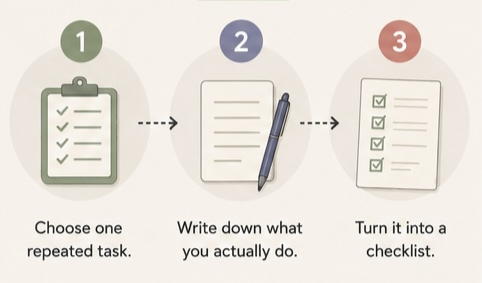
Start with one process you repeat often. Choose something practical, such as:
Requesting missing client documents
Onboarding a new client
Completing a bank reconciliation
Preparing monthly reports
Reviewing completed bookkeeping
Following up on unanswered questions
The next time you complete that process, write down what you actually do.
Do not begin by trying to create the perfect procedure. Document the real process first. Include the small steps that feel obvious to you but may not be obvious to someone else.
For example:
Where do you look for the information?
What tells you something is complete?
What common problems should someone watch for?
When should the client be contacted?
Where should notes be recorded?
What needs to happen before the task can be marked finished?
Once the steps are written down, turn them into a checklist that your future self could follow without having to reconstruct the process from memory.
The first time through, documenting the process will feel slower than doing the task the way you always have. Every time after that, the documented version pays for itself, whether you're the one using it, training someone else on it, or fixing it because something changed.
Why I Built Bookkeeping Inspired
I am Karmen, founder of Bookkeeping Inspired, and I have worked in the bookkeeping industry for more than twenty-five years. I have also spent more than sixteen years building and running my own bookkeeping firm.
The systems in my firm were not created all at once. They were built over time because the business needed them.
As the client base grew, it became clear that I could not continue relying on memory, informal instructions, and processes that only made sense because I was the person completing them.
I needed consistent onboarding. I needed a monthly close process that could be followed and reviewed. I needed better ways to manage deadlines, client communication, employees, documents, and recurring work.
Most of what I now teach through Bookkeeping Inspired came from solving those problems inside a working bookkeeping firm.
Bookkeeping Inspired was created to help other bookkeepers build the operating structure that is often missing between knowing how to do the work and knowing how to run the business.
What You Will Find Here
This blog is not focused on basic QuickBooks tutorials or instructions for clicking through software screens. There are already many good resources available for that.
The focus here is the business of running a bookkeeping firm well, including topics such as:
Building repeatable workflows
Managing the monthly close
Creating consistent client experiences
Pricing and defining scope
Training and delegating work
Improving client communication
Generating referrals
Using AI thoughtfully inside a bookkeeping firm
Building a firm that does not depend on the owner for every decision
The goal is to help you understand not only what to do, but how the pieces of a well-run firm fit together.

Join the Conversation
For ongoing conversations with other bookkeepers and firm owners, join the Inspired Modern Bookkeepers Facebook Group.
If you'd rather get new articles by email, you can subscribe to the Bookkeeping Inspired newsletter instead.
Frequently Asked Questions
-
It means the recurring work in your firm follows a defined process instead of depending on memory. Responsibilities are clear, and there's a consistent way to know when something is done.
-
No. You can start with a checklist or a written procedure in whatever tool you already use, whether that's Notion, a shared doc, or a plain page in a binder. Software can make a system easier to assign and track once it exists, but the process has to exist first. The tool comes second.
-
A checklist lists the steps that need to happen. A standard operating procedure, or SOP, explains how and why those steps happen, usually with more detail, examples, or decision points built in. Some processes only need a checklist. Others, especially ones with judgment calls or exceptions, need the fuller SOP treatment.
-
Whenever it stops matching what you do. A process is worth revisiting any time a client type changes, a tool changes, or you catch yourself working around a step instead of following it. Treat the document as a working draft, not a finished policy. Firms that document once and never touch it again usually end up with a binder nobody trusts.
-
That's worth looking into before deciding which version is correct, since it usually means the documented process left something out or wasn't reviewed after training. Sit with both people, walk through what each of them does, and update the documentation to reflect whichever version produces the more consistent, reviewable result. The goal isn't to catch someone doing it wrong. It's to make the process complete enough that there's only one way to follow it.
-
Yes. The same structure, a clear trigger, defined steps, and a way to know the work is done, applies to any recurring part of the firm, not just the monthly close. Advisory conversations, tax season prep, cleanup projects, and payroll all take a repeatable shape once you've run them a few times. Monthly bookkeeping is the example here because most firms deal with it every month, but the same approach works for anything else your firm offers.
Related Resources
Close With Confidence A practical guide to building a faster, cleaner, and more consistent monthly close process.
The Referral Effect A guide to creating a referral process that fits naturally into the way you already serve clients.
Keep What's Yours A practical guide to using AI in your firm without losing the judgment and relationships that make you valuable.