
The Bookkeeping Firm Systems Audit: 12 Questions That Reveal Exactly Where You're Leaking Time and Money

You close out a month and something about it doesn't sit right. Revenue's fine. Clients are paying. But you spent Saturday morning chasing down a missing bank statement that should have been flagged three weeks earlier, and you can't remember the last time that didn't happen.
That feeling isn't useless, but it's not specific enough to act on. "Something feels off" doesn't tell you where to start fixing it. Twelve honest questions do.
This is a systems audit built to run on your own firm in about ten minutes: 12 questions across the five places time and money most often leak out of a bookkeeping firm, client management, monthly close, communication, pricing, and documentation. No single question will reveal a crisis. The pattern across your answers will.
Table of Contents
The Feeling That Something's Off
How This Audit Works
Client Management
Monthly Close
Communication
Pricing
Documentation
What the Pattern Reveals
Where to Start
FAQ
How This Audit Works
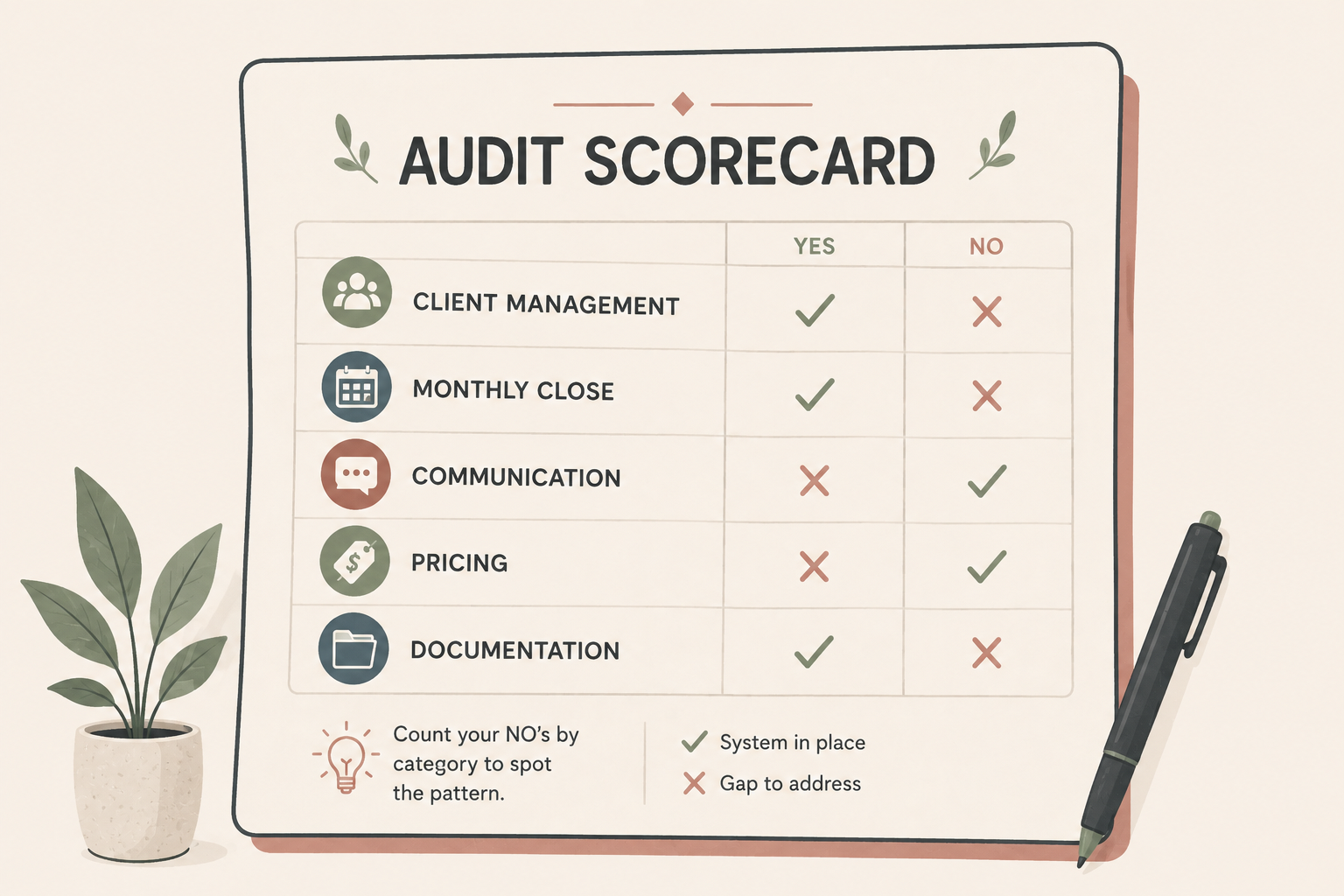
Read each question. Answer honestly, not the answer that sounds better out loud. At the end, count your no's by category. One or two scattered no's isn't a problem, every firm has a couple of loose threads. Four or more clustered in the same category is the signal worth paying attention to. That's not a random gap. That's a place your firm has been quietly running without a system.
Client Management
Does every new client go through the same onboarding steps, or does it depend on who happened to bring them in and how busy that week was?
Could someone else in your firm answer a client's routine question about their account without pulling you in first?
Do you know right now which of your clients are the least profitable, or would you have to go dig for that?
A firm running on memory instead of a system usually fails at least one of these without realizing it. The first question is about consistency: if onboarding shifts based on mood or bandwidth, new clients get a different experience depending on timing that has nothing to do with them. The second is about whether the firm depends on you personally for information that should live somewhere else. The third is about whether you're looking at the numbers or assuming your biggest clients are your best ones.
Monthly Close
Is your close process written down somewhere a person other than you could follow, or does it live in your head?
If you took two weeks off starting today, would your monthly close still happen on time?
Do you close every client on the same schedule, or does the order shift week to week with no consistent reason why?
These three test the same thing from different angles: does the close depend on you being present and remembering everything, or does it run whether you're there or not. A close process that only lives in your head isn't a process. It's a habit that happens to work as long as nothing interrupts it.
Close With Confidence walks through what a documented close actually needs to hold.
Communication
Do your clients know when to expect updates from you, or do they have to ask?
Is there a standard response time for client emails, or does it depend on how busy that particular week is?
Clients rarely complain about slow communication directly. They quietly start wondering if anyone's paying attention, and that's the moment a good client starts shopping around. If the answer to either question changes depending on your mood or workload that week, your clients are feeling that inconsistency even when they never say so out loud.
Pricing
Do you know your effective hourly rate on every client, not just the number on the invoice?
Has a client's scope grown since you priced them, without the price growing to match?
Most bookkeepers can tell you what they charge. Fewer can tell you what they're making per hour once the true time on a client is counted. The gap between those two numbers is where a firm quietly loses profit without anyone deciding it should.
Worth What You Charge is built for exactly this gap.
Documentation
If someone started working in your firm tomorrow, could they find your process for a task without asking you?
Do you have a documented way clients exit the firm, or does every offboarding look different depending on the situation?
Both of these ask the same underlying question: does the knowledge that runs your firm exist anywhere besides your own memory. If the honest answer is no, that's not a personal failing. Most bookkeeping firms are built exactly this way in the early years. It stops being sustainable once the firm has grown past what one person can hold in their head.
What the Pattern Reveals
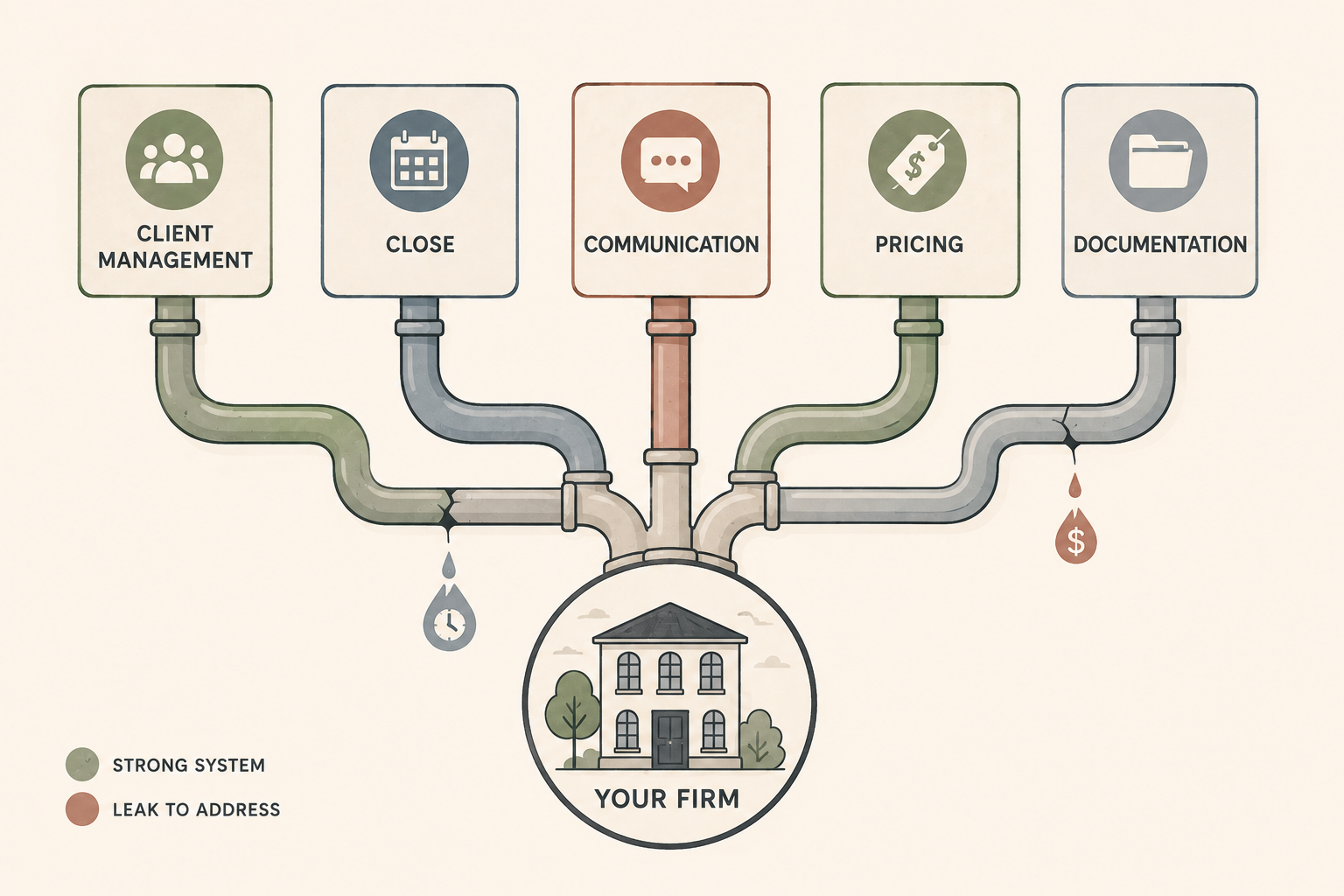
Count your no's by category before you count them overall. A firm with two or three no's scattered across different categories is in reasonably good shape. A firm with four or more no's clustered in one category has found something worth fixing first.
Client management gaps usually show up as an inconsistent client experience.
Close gaps usually show up as late closes or late nights.
Communication gaps usually show up as client churn that's hard to explain.
Pricing gaps show up as revenue that looks fine on paper and profit that doesn't.
Documentation gaps show up the moment you try to hire, delegate, or take real time off.
The free Inspired Firm Diagnostic is a good next step once you've run this audit, a broader 18-question look across 6 areas of your firm (client lifecycle, operations, additional services, firm management, marketing, and AI), so you can see whether the gaps you just found here show up elsewhere too.
Join the Conversation
For ongoing conversations with other bookkeepers and firm owners, join the Inspired Modern Bookkeepers Facebook Group.
If you'd rather get new articles by email, you can subscribe to the Bookkeeping Inspired newsletter instead.
Frequently Asked Questions
-
Once or twice a year is enough for most firms. More often than that and you're auditing instead of fixing. The value is in acting on what you find, not repeating the exercise.
-
That's more common than it sounds, and it usually means the firm grew faster than the systems did, not that anything was done wrong. Start with the single category that has the most no's instead of trying to fix five things at once.
-
No. Firms that feel stable are often the ones with the most to gain from running it, because a quiet no might otherwise go unnoticed until it turns into a bigger problem: a client leaving, a close that slips, a hire that doesn't work out.
-
No. A notebook or a blank doc is enough. The audit is about the questions and the honesty of the answers, not the tool you use to record them.