

I followed a lot of sensible advice when I was building my bookkeeping business.
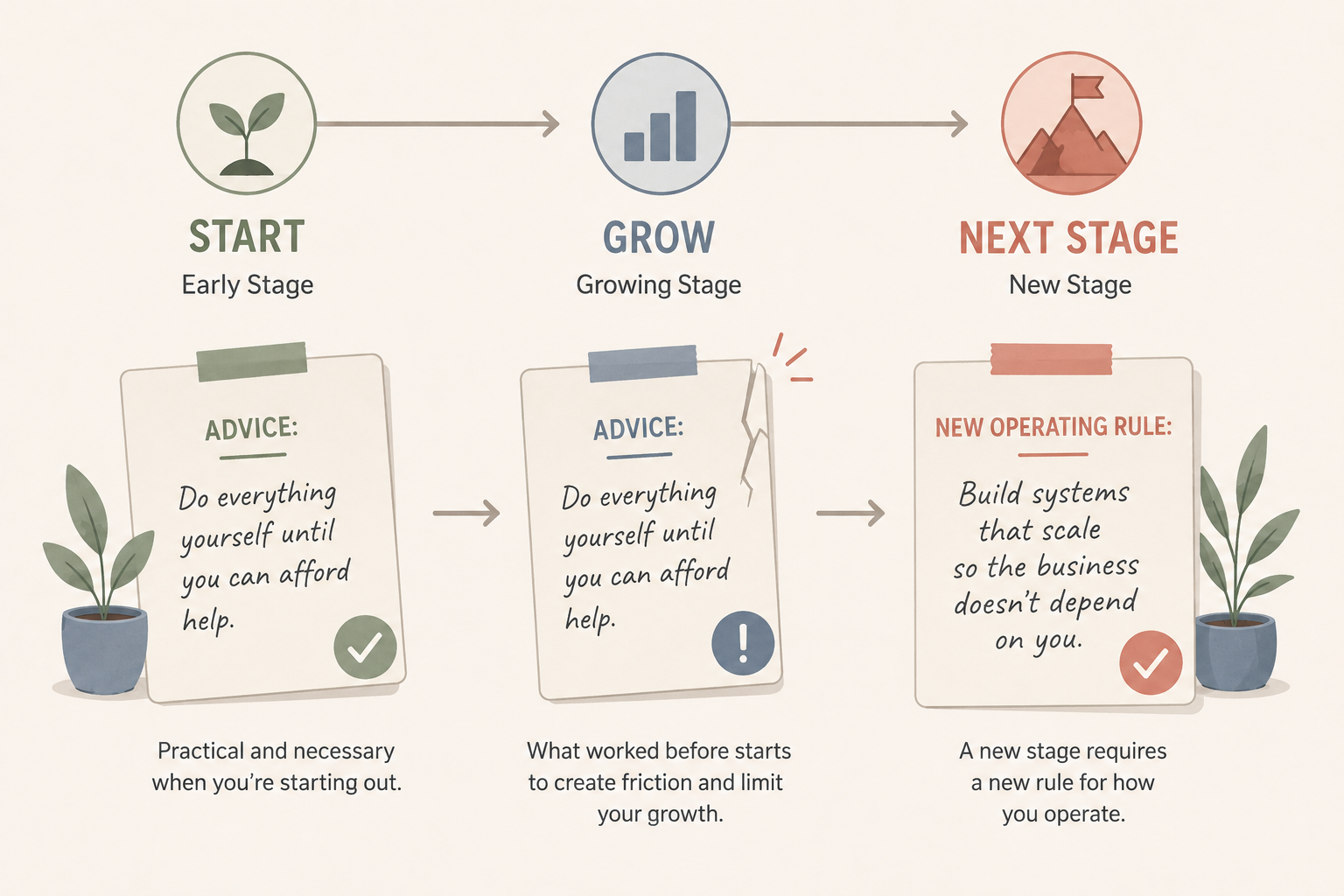
Some of it helped. Some of it probably kept me afloat during stages when there was no team, no extra capacity, and no room for anything complicated.
Then something strange happened. The business changed, but several of the rules I was following didn't.
What had once been practical started creating problems of its own.
That is the part of business advice we don't talk about enough. Advice can be useful without being permanent.
Table of Contents
The Seven Rules I Eventually Had to Question
The Problem Is Not That the Advice Was Bad
A Better Way to Decide What to Keep
Frequently Asked Questions
The seven rules I eventually had to question
1. Do everything yourself until you can afford help
This makes perfect sense at the beginning. If there is no money for help, there is no money for help.
The problem is that "until I can afford it" can quietly become "until I have enough spare time to teach someone," and that day may never arrive.
I spent years being the fastest person at certain tasks because I had done them hundreds of times. That efficiency made it very easy to keep them.
Eventually I had to ask a different question: what is it costing the business for me to remain the only person who can do this?
That changed the calculation completely.
2. Your clients hired you, so they should always have access to you
I believed this one for a long time.
Being responsive felt like part of the service. If a client emailed me, I wanted them to know I was available. If there was a question, I wanted to be the person who answered it.
But access and service are not the same thing.
A client can have an excellent experience without every question routing through the owner. In fact, the business becomes more reliable when answers do not depend on whether one person is available that afternoon.
The shift was learning to separate the client relationship from constant owner access.
3. Busy means the business is growing
Busy can mean growth.
It can also mean poor pricing, too much customization, weak processes, the wrong clients, or work that should have been handed off six months ago.
There were periods when my calendar was packed and I would have described the business as successful because there was so much work.
But a full schedule is a measure of demand on your time. It is not automatically a measure of business quality.
Revenue, margin, capacity, client fit, and how much of the work requires the owner tell you far more.
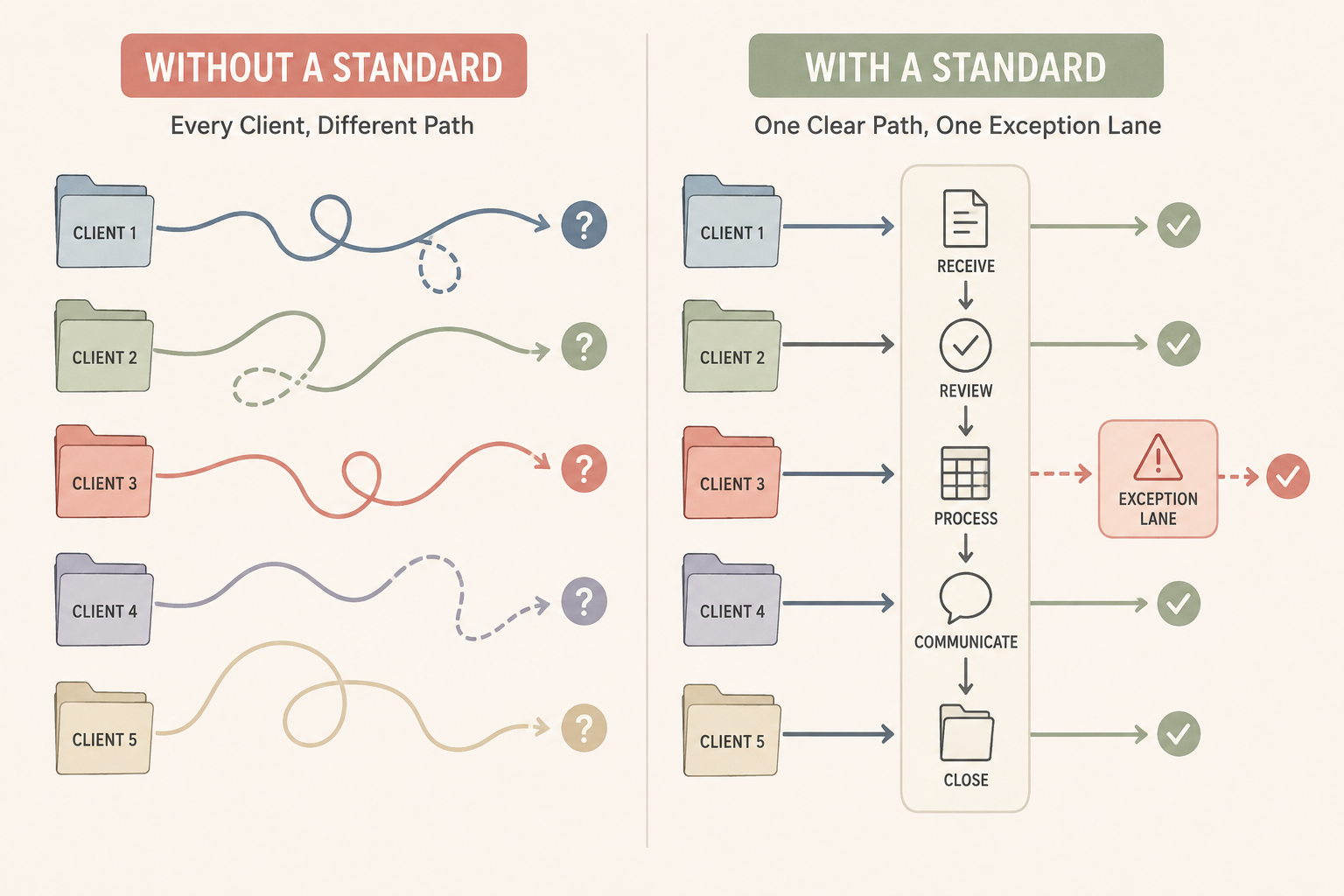
4. Stay flexible for every client
Flexibility sounds like great service, especially in bookkeeping where every client arrives with different software, habits, deadlines, and preferences.
But there is a difference between adapting to a legitimate client need and inventing a new operating process for every client.
The more exceptions I allowed, the harder it became for anyone else to know what "normal" looked like.
Standardization did not make the service less personal. It gave us a reliable base so the exceptions were obvious when they appeared.
That same shift from effort to structure is what I wrote about in Systems Over Hustle: the goal is not to squeeze more work into the week, but to change what the business requires from you.
5. More clients means a more successful business
For a long time, client count was an easy number to feel good about.
It was visible. It grew. It made the business look established.
But ten poorly priced, high-maintenance clients can create more strain than five profitable clients who fit the way the business operates.
At some point, adding clients stopped being the obvious answer.
The better question became: does this client make the business stronger after the work, margin, communication load, and capacity are considered?
That is a much harder number to brag about, but a much more useful one to run a business on.
6. Build systems when things slow down
This may be the most expensive advice on the list because it sounds so reasonable.
You will document the process when month-end is over. You will clean up the client database when tax season ends. You will build the checklist when the team is less busy.
The trouble is that a busy bookkeeping business rarely hands you a quiet month and asks what you would like to improve.
The absence of systems is often part of why the business stays busy. My Bookkeeping Firm Systems Audit is useful for spotting exactly which parts of the business are still relying on memory, owner involvement, or inconsistent processes.
I eventually learned to build while the problem was visible. A recurring question, a missed handoff, or a task that only I could complete became the signal to capture the process then, not someday after the pressure disappeared.
7. If it is working, don't change it
This one kept me in old processes longer than I want to admit.
Working is a very low standard.
A process can technically work while taking too long. It can work while depending on one person. It can work while creating three follow-up emails and a spreadsheet nobody trusts.
The question I use now is different: does this still fit the business we are trying to run?
That leaves room for something to have worked well in one stage and still deserve to be replaced in the next.
The problem is not that the advice was bad
Most of these rules helped at some point.
That matters because it changes how I think about unlearning them. I do not need to prove I was wrong to change how I operate now.
The business simply outgrew the rule.
That is why I think the most useful review is not "what am I doing badly?" It is "what am I still doing because it used to make sense?"
A better way to decide what to keep
Pick one recurring frustration in your business right now.
Then ask:
What rule or assumption is underneath the way I currently handle this?
Was that rule chosen intentionally, or did it develop because I was doing everything myself?
Does it still fit the size and direction of the business now?
What would I build differently if I were starting this process today?
You do not need to rebuild the business in a week. One outdated rule is enough to start with.
If you want a more structured look at where your business may have outgrown its current systems, the free 18-question Inspired Firm Diagnostic walks through six areas of the business and shows you where things are solid and where they may be costing you time and money.
Take the free Inspired Firm Diagnostic
Frequently Asked Questions
-
Look at the outcome the advice was supposed to create. If you have followed it consistently and the result now creates a bottleneck, unnecessary owner involvement, low margins, or complexity that did not exist earlier, the business may have outgrown the rule rather than failed to execute it.
-
No. Standardize the parts that should be predictable: recurring workflows, handoffs, communication expectations, document collection, and routine decisions. Keep room for exceptions where professional judgment or a client's circumstances genuinely require them.
-
Before the owner is completely out of capacity. The best first candidates are recurring tasks with clear triggers, repeatable steps, and limited judgment. Waiting until the business is overwhelmed makes both documenting and training harder.
-
Start with the one creating the most repeated friction. If you are not sure which area matters most, use the Inspired Firm Diagnostic to identify the strongest and weakest parts of the business before choosing a project.
Stay Connected
The Inspired Bookkeeper on Substack
Deeper, more personal writing on running a bookkeeping business. Two posts a week.
Read on Substack →Inspired Modern Bookkeepers
The conversation doesn't have to end here. Bring it to the group.
Join the Group →Get Articles by Email
Weekly insights for bookkeeping business owners, straight to your inbox.
No spam. Check your inbox to confirm.