
If Bookkeeping Were Free, Fast, and Perfect, Would Your Clients Still Need You?
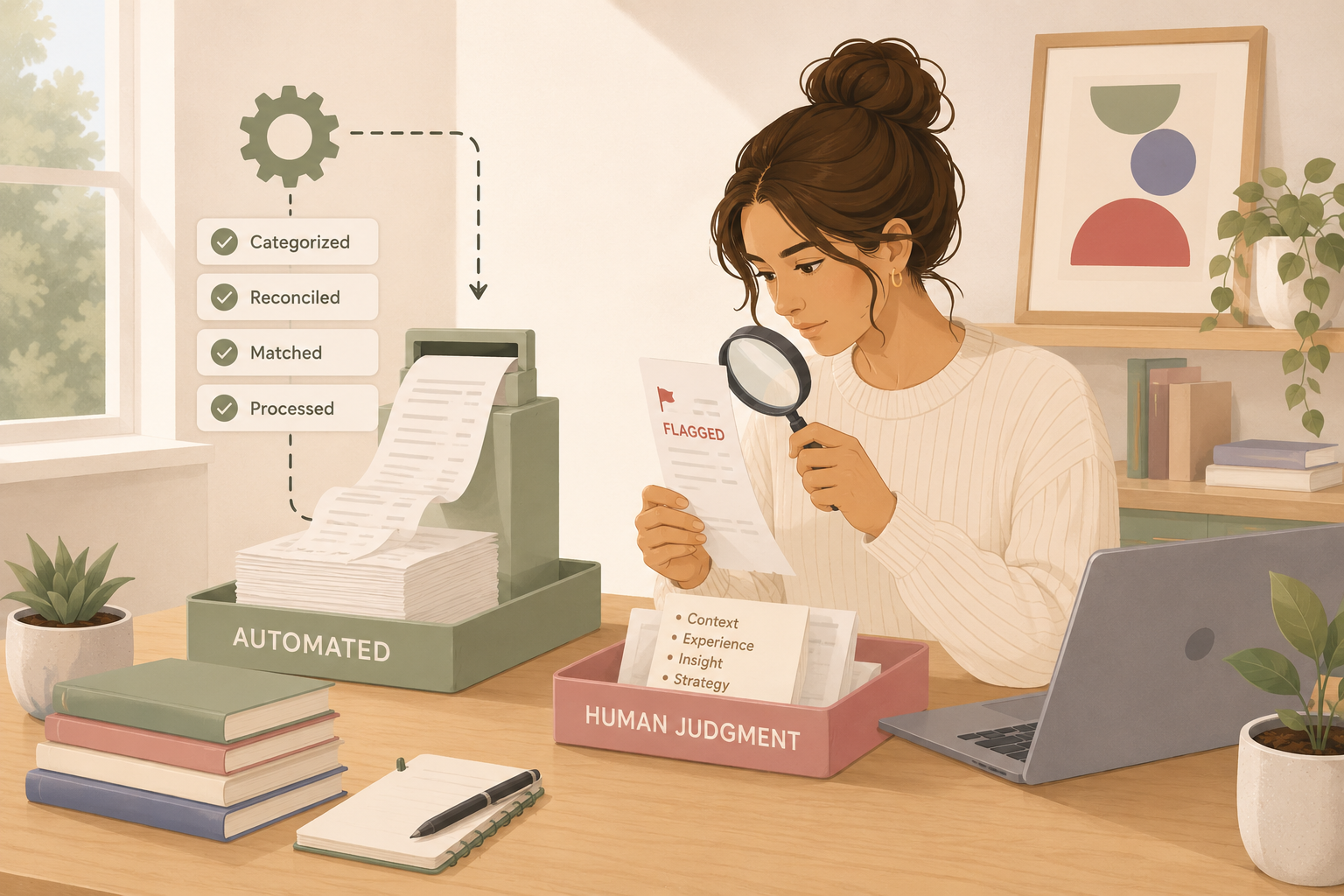
Imagine your month-end close finished itself tomorrow. Every transaction categorized correctly, every account reconciled, no missing receipts to chase down. The software did it in minutes, and it didn't make a single mistake.
Would your clients still pay you?
That question used to be hypothetical. It isn't anymore.
Last week I wrote about what happens when a firm runs on memory instead of structure, Systems Over Hustle. This week's question is a sharper version of the same argument, and it starts with what's changing fastest.
Table of Contents
The Question Worth Sitting With
What AI Is Actually Getting Good At
Why Free and Perfect Doesn't Mean Replaceable
What Judgment Actually Looks Like in a Bookkeeping Firm
The Gap Between What Courses Teach and What Templates Give You
Building the Thing That Makes a Firm AI-Proof
The North Star Question
FAQ
What AI Is Actually Getting Good At
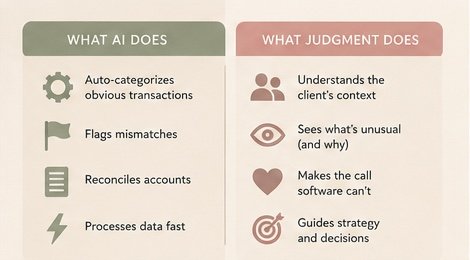
The mechanical side of bookkeeping, data entry, categorization, reconciliation, is the part AI tools are closing in on fastest. Bank feeds already auto-categorize the obvious transactions. Reconciliation tools already flag mismatches without a human opening a single statement. None of this is science fiction. It's already sitting inside the software most firms use today, and it's getting better every quarter.
For a firm owner watching this happen, the instinct is to worry about the wrong thing. The worry lands on "will the software replace me," when the more useful question is "what was I being paid for in the first place."
Why Free and Perfect Doesn't Mean Replaceable
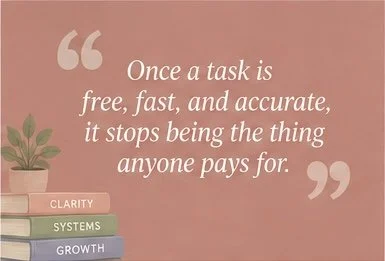
Here's the part that gets missed. Once a task is free, fast, and accurate, it stops being the thing anyone pays for.
Nobody pays a premium for something a tool does automatically and correctly.
What's left standing after the mechanical work disappears is the judgment behind it, the decisions that don't fit a pattern the software was trained on.
A reconciliation tool can match a transaction to a category. It can't tell you that a client's usual vendor payment looks different this quarter because they recently took on a new supplier, and that the "unusual" flag the software would raise is actually correct, on-plan spending. That call takes knowing the client, not knowing the software.
What Judgment Actually Looks Like in a Bookkeeping Firm
This isn't abstract. It shows up constantly, in small decisions most bookkeepers make without noticing they're making them.
A client's contractor payment gets coded as a standard vendor expense by default. You know that contractor just shifted from project-based work to a retainer, which changes how it should be classified. The software has no way to know that. You do, because you talked to the client last month.
A recurring software subscription looks identical every month until the one month it isn't, a price increase buried in the transaction, a duplicate charge from a failed cancellation. Automated categorization will wave both through. A bookkeeper paying attention catches it before it becomes the client's problem three months later.
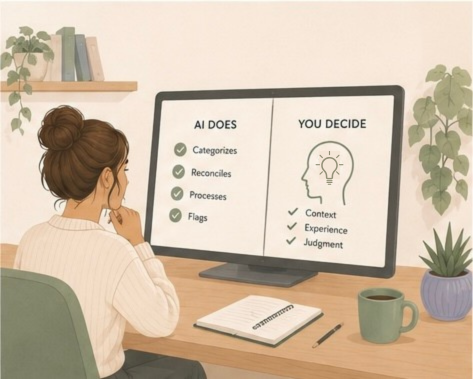
None of that is a task. It's a judgment call, made by someone who understands why the process exists, not just how to run it.
The Gap Between What Courses Teach and What Templates Give You
This is where most bookkeeping education leaves a hole. Courses teach the thinking, why a step matters, how to make the judgment call, then leave you to build your own tools to actually run the work. Templates hand you the tool, a spreadsheet, a checklist, a Notion board, with none of the reasoning behind it. You get the "what" without the "why," or the "why" without anything to actually do with it.
Quick Win: Pick one judgment call you make for a client every month without thinking twice about it, a categorization decision, a flag you catch that software wouldn't. Write down why you make it that way. That single sentence is the start of documenting the exact thing a client is actually paying you for.
Either way, you're the one left building the bridge between the two, usually while also running client work.
I get into more of this kind of thinking every week on Substack.
Building the Thing That Makes a Firm AI-Proof
The Inspired Firm OS exists because that bridge shouldn't have to be built alone, over and over, by every bookkeeper who hits this wall. Every module runs the actual task in front of you and explains the reasoning behind it while you use it, so the judgment gets documented instead of staying stuck in your head, where it disappears the moment you're not the one doing the work.
That's the same asset that makes a firm hold up against AI, not because the software can't do the mechanical steps, but because the documented judgment behind those steps is what AI still can't replicate, and it's what a client is paying for once the mechanical work stops being worth anything on its own.
That documented judgment is also what the Inspired Modern Bookkeeper AI Team runs on, Meet the AI Team. It already knows your firm's standards instead of starting from a blank prompt every time.
The North Star Question
So here's the question worth sitting with, the one that started this post: if the mechanical work disappeared tomorrow, free, fast, and accurate, what would still make a client choose you?
If the honest answer is "nothing yet," that's not a reason to panic. It's a reason to start documenting the judgment you're already using every day, before the mechanical work that used to justify your invoice quietly stops being worth billing for. Joining the Firm OS Waitlist is a good place to start, you'll be first to see it when it launches.
Join the Conversation
For ongoing conversations with other bookkeepers and firm owners, join the Inspired Modern Bookkeepers Facebook Group.
If you'd rather get new articles by email, you can subscribe to the Bookkeeping Inspired newsletter instead.
Frequently Asked Questions
-
Not the judgment side of the work. AI is closing in fast on the mechanical tasks, data entry, categorization, reconciliation, but the decisions that require knowing a specific client's situation still need a person who understands why a process exists, not just how to run it.
-
Start documenting the judgment calls you're already making, the exceptions you catch, the reasons you handle certain situations differently than the standard case. That documentation is what separates a firm built on judgment from one built purely on task completion.
-
Related, but not identical. An SOP documents the steps. Documenting judgment means capturing why a step exists and what to do when a situation doesn't fit the standard case, the part that usually only lives in the owner's head.
-
They notice it when it's missing, the error that gets caught, the situation handled correctly the first time instead of needing a fix later. Making that judgment visible in how you communicate with clients is part of the work, not separate from it.
Related Resources
Keep What's Yours A practical guide to using AI in your firm without losing the judgment and relationships that make you valuable.
Close With Confidence A practical guide to building a faster, cleaner, and more consistent monthly close process.
Worth What You Charge A practical guide to pricing your work with confidence instead of guessing at what you're worth.